Scientific work at the intersection of nonlocal mechanics, mathematical physics, optimization and artificial intelligence. Browse research articles, academic talks, outreach and theses.
START HERE
Selected research
Recent publications and selected scientific contributions. Explore the full archive below, or download the complete publication list.
Articles, preprints and research notes in mathematical physics, nonlocal mechanics, artificial intelligence and applied modeling.
14 ENTRIES
2026
Preprint
When Nonlocal Total Derivatives Are Not Variationally Trivial
Preprint: arXiv – 2611.14612 [hep-th] Date: Nov 13, 2026 Authors: Carlos Heredia
Read abstract & materials
We study total time derivatives in infinite-order and nonlocal Lagrangian mechanics. In the formal infinite-order setting, such terms remain variationally trivial. For nonlocal functionals on trajectories, however, exactness in the form \(L=DW\) is not sufficient to ensure a vanishing nonlocal Euler-Lagrange expression. We exhibit a smooth convolution-type counterexample.
2026
Journal article
Integrable Elasticity via Neural Demand Potentials
We propose the Integrable Context-Dependent Demand Network (ICDN), a demand-first neural model for multiproduct retail demand. The model learns log-demand as a smooth, context-conditioned function of log-prices, allowing elasticities to be derived exactly from the learned demand surface. On the Dominick’s beer dataset, ICDN improves out-of-sample generalization over a directed log-log benchmark and yields more stable, economically plausible elasticity estimates, especially for weakly identified cross-price effects.
2026
Preprint
From Adam to Adam-Like Lagrangians: Second-Order Nonlocal Dynamics
Preprint: arXiv – 2602.09101 [cs.LG] Date: Feb 11, 2026 Authors: Carlos Heredia
Read abstract & materials
In this paper, we derive an accelerated continuous-time formulation of Adam by modeling it as a second-order integro-differential dynamical system. We relate this inertial nonlocal model to an existing first-order nonlocal Adam flow through an \(\alpha\)-refinement limit, and we provide Lyapunov-based stability and convergence analyses. We also introduce an Adam-inspired nonlocal Lagrangian formulation, offering a variational viewpoint. Numerical simulations on Rosenbrock-type examples show agreement between the proposed dynamics and discrete Adam.
We introduce a Hamiltonian framework for nonlocal Lagrangian systems without relying on infinite-derivative expansions. Starting from a (trajectory-based) variational principle and a generalized Noether theorem, we define the canonical momenta and energy. Moreover, we construct a (pre)symplectic form on the kinematic space, and show that its restriction to the phase space (by implementing the constraints) yields a true (pre)symplectic structure encoding the dynamics. Three examples — a finite nonlocal oscillator, the fully nonlocal Pais-Uhlenbeck model, and a delayed harmonic oscillator — demonstrate how phase space and the Hamiltonian emerge without explicitly solving the Euler-Lagrange equations.
2024
Preprint
Modeling AdaGrad, RMSProp, and Adam with Integro-Differential Equations
Preprint: arXiv – 2411.09734 [cs.LG] Date: Nov 18, 2024 Authors: Carlos Heredia
Read abstract & materials
In this paper, we propose a continuous-time formulation for the AdaGrad, RMSProp, and Adam optimization algorithms by modeling them as first-order integro-differential equations. We perform numerical simulations of these equations to demonstrate their validity as accurate approximations of the original algorithms. Our results indicate a strong agreement between the behavior of the continuous-time models and the discrete implementations, thus providing a new perspective on the theoretical understanding of adaptive optimization methods.
2024
Journal article
Infinite Derivatives vs Integral Operators. The Moeller-Zwiebach Puzzle
We study the relationship between integral and infinite-derivative operators. In particular, we examine the operator \(p^{\frac12\,\partial_t^2}\) that appears in the theory of \(p\)-adic string fields, as well as the Moyal product that arises in non-commutative theories. We also try to clarify the apparent paradox raised by Moeller and Zwiebach, which highlights the discrepancy between them.
2024
Journal article
Nonlocal Lagrangian fields and the second Noether theorem. Non-commutative U(1) gauge theory
This article focuses on three main contributions. Firstly, we provide an in-depth overview of the nonlocal Lagrangian formalism. Secondly, we introduce an extended version of the second Noether’s theorem tailored for nonlocal Lagrangians. Finally, we apply both the formalism and the extended theorem to the context of non-commutative U(1) gauge theory, including its Hamiltonian and quantization, showcasing their practical utility.
2024
Preprint
Are nonlocal Lagrangian systems fatally unstable?
Preprint: arXiv – 2403.19777 [hep-th] Date: Mar 1, 2024 Authors: Carlos Heredia and Josep Llosa
Read abstract & materials
We refute the false belief that Lagrangians, both higher-order and nonlocal, lead inexorably to instability, and an extensive variety of counterexamples are provided for both higher-order and genuinely nonlocal systems.
2023
Journal article
Electromagnetic interaction models for Monte Carlo simulation of protons and alpha particles
Electromagnetic interactions of protons and alpha particles are modeled in a form that is suitable for Monte Carlo simulation of the transport of charged particles. The differential cross section (DCS) for elastic collisions with neutral atoms is expressed as the product of the DCS for collisions with the bare nucleus and a correction factor that accounts for the screening of the nuclear charge by the atomic electrons. The screening factor is obtained as the ratio of the DCS for scattering of the projectile by an atom with a point nucleus and the parameterized Dirac-Hartree-Fock-Slater (DHFS) electron density, calculated from the eikonal approximation, and the Rutherford DCS for collisions with the bare point nucleus. Inelastic collisions, which cause electronic excitations of the material, are described by means of the plane-wave Born approximation, with an empirical simple model of the generalized oscillator strength (GOS) that combines several extended oscillators with resonance energies and strengths determined from the atomic configurations and from the empirical mean excitation energy of the material. The contributions from inner subshells are renormalized to agree with realistic ionization cross sections calculated numerically from the DHFS self-consistent model of atoms by means of the plane-wave Born approximation. The resulting DCS allows analytical random sampling of individual hard inelastic interactions.
2022
Journal article
Nonlocal Lagrangian fields: Noether’s theorem and Hamiltonian formalism
This article aims to study non-local Lagrangians with an infinite number of degrees of freedom. We obtain an extension of Noether’s theorem and Noether’s identities for such Lagrangians. We then set up a Hamiltonian formalism for them. In addition, we show that \(n\)-order local Lagrangians can be treated as a particular case and the standard results can be recovered. Finally, this formalism is applied to the case of \(p\)-adic open string field.
2022
Journal article
Infinite-derivative linearized gravity in convolutional form
Journal:Classical and Quantum Gravity, 39, 085001 Date: Mar 22, 2022 Authors: Carlos Heredia, Ivan Kolář, Josep Llosa, Francisco José Maldonado Torralba, and Anupam Mazumdar
Read abstract & materials
This article aims to transform the infinite-order Lagrangian density for ghost-free infinite-derivative linearized gravity into non-local. To achieve it, we use the theory of generalized functions and the Fourier transform in the space of tempered distributions \(\mathcal{S}^\prime\). We show that the non-local operator domain is not defined on the whole functional space but on a subset of it. Moreover, we prove that these functions and their derivatives are bounded in all \(\mathbb{R}^3\) and, consequently, the Riemann tensor is regular and the scalar curvature invariants do not present any spacetime singularity. Finally, we explore what conditions we need to satisfy so that the solutions of the linearized equations of motion exist in \(\mathcal{S}^\prime\).
2021
Journal article
Non-local Lagrangian mechanics: Noether’s theorem and Hamiltonian formalism
Lagrangian systems with a finite number of degrees of freedom that are non-local in time are studied. We obtain an extension of Noether’s theorem and Noether identities to this kind of Lagrangians. A Hamiltonian formalism has then been set up for these systems. n-order local Lagrangians can be treated as a particular case of non-local ones and standard results are recovered. The method is then applied to several other cases, namely two examples of non-local oscillators and the p-adic particle.
2021
Research note
Comment on "Dynamics with Infinitely Many Derivatives: The Initial Value Problem"
PDF: To consult it, click here Date: June 8, 2021 Authors: Carlos Heredia and Josep Llosa
Read abstract & materials
The definition of fractional operators usually resorts to Laplace transforms and convolution. Since the “natural” arena for the latter seems to be the space of generalised functions with support on a half-line, we pinpoint some useful notions extracted from Equations of Mathematical Physics – V. S. Vladimirov (sections from 10.2 to 10.4). Using these notions, we make some comments about the article «Dynamics with Infinitely Many Derivatives: The Initial Value Problem».
2021
Journal article
Energy-momentum tensor for the electromagnetic field in a dispersive medium
On the basis of a non-local Lagrangian for Maxwell equations in a dispersive medium, the energy-momentum tensor of the field is derived. We obtain the Field equations through variational methods and an extension of Noether theorem for a non-local Lagrangian is obtained as well. The electromagnetic energy-momentum tensor obtained in the general context is then specialized to the case of a field with slowly varying amplitude on a rapidly oscillating carrier.
Academic exchange
Talks & Posters
Conference presentations, research seminars and scientific posters, with original slides and recordings where available.
8 ENTRIES
2025
Poster
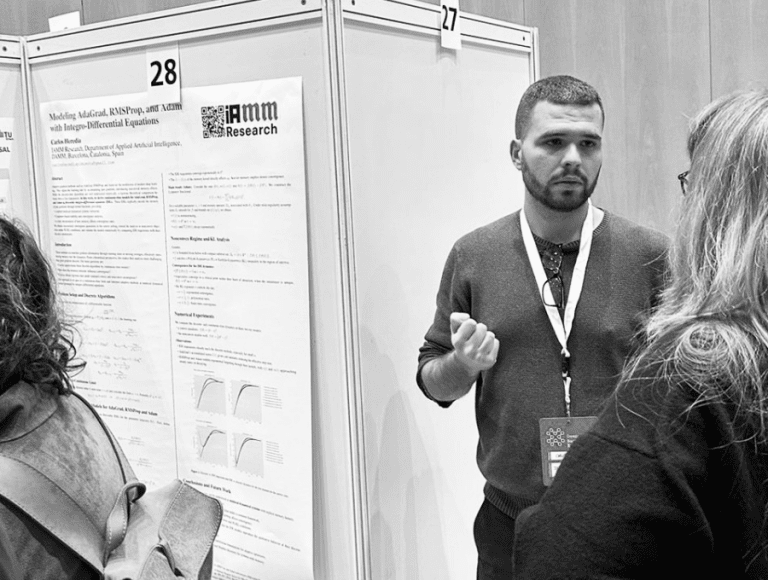
Modeling AdaGrad, RMSProp, and Adam with Integro-Differential Equations
Adaptive gradient methods such as AdaGrad, RMSProp, and Adam are the workhorses of modern deep learning. They adjust the learning rate by accumulating past gradients, introducing non-trivial memory effects. While the discrete-time algorithms are well understood empirically, a rigorous theoretical comparison between them is less transparent. In this work, we derive continuous-time models for AdaGrad, RMSProp, and Adam as first-order integro–differential equations (IDEs).
2023
Talk
Decoding Non-Locality: Lagrangian and Hamiltonian formulations, and Noether’s theorem
In this talk, we will delve into the realm of non-locality in physics, with a specific focus on the concepts elucidated in the articles [arXiv] 2203.02206, 2105.10442, and 2310.03070. We will expound upon our proposal for a Lagrangian formulation tailored for systems that manifest non-local properties. Furthermore, we will present our extension of Noether’s Theorem to address this distinctive scenario. Beyond that, leveraging the local case as a point of reference, we will scrutinize the Legendre transformation applied to these systems. Through this analysis, we aim to introduce our Hamiltonian formalism adapted for non-local systems. Our exploration of non-locality in this presentation will adopt a perspective grounded in integro-differential operators.
2023
Talk
Navegando en la No Localidad: Lagrangianos, Hamiltonianos y el Teorema de Noether
[Castellano] En esta presentación, nos adentraremos en el campo de la no localidad en física, centrándonos en los conceptos desarrollados en los artículos [arXiv] 2203.02206, 2105.10442 y 2310.03070. Expondremos nuestra propuesta de formulación Lagrangiana para sistemas que exhiben propiedades no locales, así como nuestra extensión del Teorema de Noether para este escenario particular. Además, tomando como referencia el caso local, examinaremos la transformación de Lagrange para estos sistemas, y, mediante ella, introduciremos nuestro formalismo Hamiltoniano aplicado a sistemas no locales. Abordaremos la no localidad en esta presentación desde una perspectiva basada en operadores integro-diferenciales.
The exploration of global and local symmetries in the realm of convolutional neural network (CNN) architectures has emerged as an intriguing area of research. In arXiv: 2105.13926 suggest that symmetries may hold significant roles in the construction of CNN architectures, and that understanding the associated conserved quantities can provide valuable insights into the dynamics of network evolution during training. In order to accomplish this objective, the first requirement is an expansion of Noether’s theorem that applies to nonlocal theories. Hence, this poster presents a novel proof of the extension of Noether’s theorem to nonlocal Lagrangians characterized by an infinite number of degrees of freedom. By establishing this extension, we unlock new possibilities for understanding complex systems governed by nonlocal operators, such as, the convolution one. It relies on arXiv: 2304.10562, and, up until now, this extension has demonstrated successful application across various scenarios. These include p-adic particles/strings, different examples of non-local harmonic oscillators, and electrodynamics of dispersive media. In each of these cases, it has proven capable of replicating established results and, most importantly, has yielded novel results.
It is well known that the essence of Noether’s theorem is the connection between symmetries and conservation laws. For this reason, this talk proposes an extension of Noether’s theorem for nonlocal theories, focusing on nonlocal Lagrangians with a finite number of degrees of freedom. In particular, the nonlocality describing this type of Lagrangian will be given by integrodifferential operators. Next, we will focus on invariance under time translations to define the (conserved) energy function. Moreover, using this conserved quantity obtained through this extension, we will infer a suitable definition for momenta, which could open up the possibility of developing a Hamiltonian formalism for such theories. This talk is mainly based on these three works: [arXiv] 2002.12725 – 2105.10442 – 2203.02206.
Symmetries are the closest concept to describe our reality. It is well known that the essence of Noether’s theorem is the connection between these symmetries and the conservation laws for theories whose dynamics are derived from a variational principle. This talk presents our proposed extension of Noether’s theorem for those theories that are nonlocal. To make it as illustrative as possible, we will focus on those Lagrangians with finite degrees of freedom. We will establish the variational principle for a nonlocal Lagrangian and derive the Lagrange equations. We will introduce the concept of nonlocal kinematic space and compare it with the local case. In addition, we will discuss what conditions a nonlocal total derivative must satisfy so that the Lagrange equations vanish identically and use the conserved quantity (obtained through this extension of Noether’s theorem) to infer a suitable definition for the momenta. With this definition, we will open the possibility of building a Hamiltonian formalism for such theories. This talk is mainly based on these three works: [arXiv] 2002.12725 – 2105.10442 – 2203.02206.
2022
Talk
Noether’s theorem for non-local Lagrangian mechanics
This talk aims to present the extension of Noether’s Theorem for Lagrangians with a finite number of degrees of freedom that are non-local in time. This talk is mainly based on the following works: [arXiv] 2203.02206 – 2105.10442
2020
Poster
Energy-momentum tensor for the electromagnetic field in a dispersive medium
This work aims to obtain the Electromagnetic Stress-Energy Tensor in a medium for a non-local theory. To get it, we generalize Minkowski electrodynamics to dispersive media. As a consequence of this generalization, the Lagrangian density becomes non-local due to the non-local dependencies of the magnetic permeability and electric permittivity. […] Then, we derive the field equations and, applying Noether’s theorem, the conserved energy-momentum tensor. Because non-local Lagrangians are seldom found in textbooks, we devote a non-local formalism to outline the field equations’ derivation and Noether’s theorem. […] To conclude, we study the obtained Belinfante Stress-Energy Tensor for plane wave solutions for a dispersive medium.
Public engagement
Outreach & Teaching
Scientific communication and educational material for wider audiences.
4 ENTRIES
2026
Outreach
Institut de Formació Contínua – IL3 : Inteligencia Artificial
PDF: To consult it, click here Date: May 15, 2026 Author: Carlos Heredia Pimienta
Read abstract & materials
[Castellano] Esta presentación explora cómo la IA ha evolucionado desde los modelos estadísticos y las redes neuronales hasta los grandes modelos de lenguaje, los transformers y los agentes inteligentes. La presentación introduce conceptos clave como Machine Learning, Deep Learning, entrenamiento, backpropagation y atención, conectándolos con aplicaciones reales en programación, automatización e investigación científica. A través de ejemplos prácticos, muestra cómo la IA puede ayudar a ajustar modelos, estimar parámetros y acelerar tareas complejas. El enfoque central es claro: la IA no sustituye el criterio científico, sino que lo amplifica cuando se usa con datos, supervisión y responsabilidad.
2025
Outreach
Chapter 2: Quantum-World
PDF: To consult it, click here Date: May 18, 2025 Author: Carlos Heredia Pimienta
Read abstract & materials
Step into the fascinating quantum realm, where particles can exist in multiple places at once, communicate instantly across vast distances, and tunnel through seemingly impossible barriers. This chapter unveils how the strange behaviors of the quantum world—like superposition, entanglement, and tunneling—are not just theoretical curiosities but real drivers of innovation in nanotechnology. From lasers and SSDs to quantum computing and personalized medicine, you’ll discover how mastering the very small is opening the door to technologies that will shape the future.
2023
Outreach
Cafès Científics UB: Intel·ligència artificial i humanitat: perills i avantatges
Speakers: Carlos Heredia Pimienta, Joost Johannes Joosten, Carles Mancho Suárez, Eloi Puertas Prats and Isidora Sáez Rosenkranz.
Read abstract & materials
[Català] Com es definiria a si mateixa la intel·ligència artificial? Quin impacte està tenint aquesta tecnologia en les nostres vides? Una societat que viu en aquest context ha de disposar d’eines que la capacitin per tenir el control i poder garantir principis bàsics com la transparència o la justícia. Ara bé, per on hauríem de començar? La intel·ligència artificial no comporta únicament perills i amenaces. Especialment en l’àmbit de la recerca, ofereix un ventall de possibilitats que cal aprofitar: quines són i quin potencial tenen?
Symmetries (in my opinion) are the closest concept we have to describe the beauty of objects. They are everywhere, from the smallest entities, such as atoms, to the largest, such as galaxies. Finding them is synonymous (at least in physics) with simplicity. However, they can be used for much more! Thanks to the work of Emmy Noether, one of the most important, relevant, and brilliant mathematicians of the 20th century, we have a potent tool for physics to deepen our understanding of the constituents of nature. For this reason, in this talk, we shall explain (in an informative way) Noether’s theorem and how symmetries can help us to understand the nature surrounding us.
Doctoral, master’s and degree-level research, including supervised work and supporting documents.
4 ENTRIES
2024
Master’s thesis
Forecasting Face-off: From Arima to Deep Learning in Financial Market Predictions
PDF: To consult it, click here Date: Dec 3, 2024 Author: Marcos Heredia (supervised by Dr. Carlos Heredia and Prof. Ernest Pons)
Read abstract & materials
This research explores the analysis of time series in financial markets and aims to expand the range of forecasting models and methods available to businesses, providing a comprehensive perspective on emerging alternatives. The goal is to equip companies with the knowledge necessary to explore and adopt the most suitable and innovative solutions for their specific needs.
2023
Ph.D. Thesis
Nonlocal Lagrangian formalism
Repository: arXiv – 2304.10562 [hep-th] (or directly here) Date: Mar 31, 2023 Author: Carlos Heredia (supervised by Prof. Josep Llosa) Presentation: PDF or Keynote
Read abstract & materials
This thesis aims to study nonlocal Lagrangians with a finite and an infinite number of degrees of freedom. We obtain an extension of Noether’s theorem and Noether’s identities for such Lagrangians. We then set up a Hamiltonian formalism for them. Furthermore, we show that \(r^{\rm th}\)-order Lagrangians can be treated as a particular case, and the expected results are recovered. Finally, the method developed is applied to different examples: nonlocal harmonic oscillator, \(p\)-adic particle, \(p\)-adic open string field, and electrodynamics of dispersive media.
2017
Master’s thesis
Hamilton-Jacobi formalism for non-involutive systems
PDF: To consult it, click here Date: Jun 20, 2017 Author: Carlos Heredia (supervised by Prof. Josep Mª Pons)
Read abstract & materials
This work aims to show our vision about the inconsistency of the integrability condition for non-involutive systems in the Hamilton-Jacobi formalism. A dimensional reduction is made to solve this issue, indicating that the reduced system contains the same dynamics as the original one. Moreover, to give consistency to our work, we will display this method in four examples.
2016
Degree thesis
Hamilton-Jacobi formalism for gauge theories
PDF: To consult it, click here Date: Jan 30, 2016 Author: Carlos Heredia (supervised by Prof. Josep Mª Pons)
Read abstract & materials
This work aims to study the Hamilton-Jacobi formalism for singular systems (or systems with gauge symmetries). We review the problem with these systems to understand the motivation to construct what is known as Dirac Hamiltonian or total Hamiltonian for the dynamics of constrained systems. We conclude with the study of the free particle in the Minkowski spacetime as an example.
We use cookies to ensure that we give you the best experience on our website. If you continue to use this site, we will assume that you agree with it.